Monday, 19 August 2013

Dos Amigos II

13.08.13
We did an interview to the health leader, a teacher and the community leader to try to understand better how life is in an indigenous community like this.


There are two things that are very easy to realize. 
  • Living conditions are very bad; there are no facilities, population is living with the bare minimum to survive.
  • The community is very united; they are a cohesive group. "We want to live well and live together, live together like a community that is what we are, sharing life and knowledge," says the school teacher.


"Here we all know each other; everyone can go in every house. All children are friends and play together," says Felton, a 13 years old boy. This also causes a lot of social pressure, "if you do something different from other people, rises much envy against you and you just don't do it, because the other people will treat you differently," says the teacher of another indigenous community of this area.

MOST SERIOUS PROBLEMS

Water

One of the biggest problems in Dos Amigos is that there are no wells, not even one. They use rainwater or they gather it of the river.
"Many children do not come to school because they are sick. My older sister is sick because of the dirty water," says Jeanette, a seven years old girl. The sewage from all communities and cities in Prinzalpoka, go into the river. This water is dirty and polluted. Moreover, the kids use to shower in the river. The latrines are also in very bad conditions.  

Health

Another huge problem is that there is not a health post or a drugs store in Dos Amigos. 
The Ministry of Health distributes the medicines once every semester, but only if the health leader is there. Once they have finished, there is no possibility to have more. The only way is going across the river to Alamikamba; it can take nearly an hour by speedboat, five hours in slow, but 12 hours if you only have the canoes to paddle (like most families here).


Felton’s father tells us “I had 14 children, two of them died of diarrhea and pneumonia when they were still babies. They got ill and we could not arrive in time to the city”.
The most common diseases are caused by contaminated water. "This year, two children under 5 years have died of easily treated diseases, like diarrhea. All because we had no time to get to the hospital or medicines", says the health leader. 

Alarm / communications system

"There is no communication system here. There is no phone coverage or satellite phone to notify in case of emergency", says the community leader, Ralph Penglas. If someone is dying and does not have the "luck" that is during the day and someone with a speedboat is traveling and can ( and want) help, the person dies. This is unacceptable and unfair. These communities have a very difficult access but these problems are solvable. It is necessary the commitment to provide them with a communication system to act in an emergency.

“In case of natural disaster, there are brigades in another community who have a satellite radio. When they receive the information that reaches an emergency, they warn in their community and then they come here by boat, and we will notify it here with a bell. Then, we collect the necessary and go away from the river", says the community leader.
The process is reversed in case someone has committed a felony, or he/she intends to do it. "If someone, for example, goes out with a machete with intent to kill someone, we go to the community with a satellite radio and they notified this to the police. Then, someone from Alamikamba comes by boat," says Mr. Penglas.

SOCIAL ORGANIZATION

“There is an indigenous territorial government with some autonomy of the central government, but still we depend on the Major of the municipality". 
"In a Community Assembly with all the population of Dos Amigos, we choose the community leader for a year” tell us Mr Penglas. He is four months in the position; does not speak well Spanish and does not seem self-confident, but he is very hummable and pleasant. 

"When there are problems between families or non-serious crime (a crime that they do not consider serious), the adults got together and made ​​a decision. In addition, the entire population of Dos Amigos meet once or twice per month and discuss community problems and make decisions”.

Land

"The land is not owned by anyone, is part of the community. There is a communal land where everyone can grow, work or take their cattle with permission from the authority.
However, each family has a smaller piece of land where only they can farm. However, it does not mean it is private property because they cannot sell it or give it. They can only give it to their family. If someone new comes to live here, we give a piece of land as well”.

Birth control and religion

In every community there is a church, always with the same style; the religion is very important. They are Christians but have some peculiarities, for example, priests can marry and have families, and women can only dress with long skirt.


Health leader confirms what we have observed "here, there is not family planning at all”. The school teacher of Auhya Pura told us "a woman once said that contraceptive methods cause cancer". Ignorance about sexual matters is common in all the communities we visited. Furthermore, "many pastors tell us that birth control is sin, it is worse for us," says a woman from Dos Amigos, mother of 8 children.


We found the same situation than in Auhya Pura: families with young parents –around 20 years old- and with many children (approx 6 per family) living in a house with one or two spaces and latrines in dreadful conditions. 

More than 60% of the population in Dos Amigos are children, most of them with malnutrition and exposed to serious health problems, many of them caused by contaminated water; but also with a poor educational system that does not guarantee that kids can even finish elementary school.
The basic rights of food, clean water, accessible health care, education and housing are part of the Rights of the Child, which should be ensure in any part of the world. However, we are especially alarmed because in Nicaragua most of the aid is concentrated in the Pacific, while the Atlantic is still forgotten and ignored.


Saturday, 17 August 2013

Dos Amigos, indigenous community.

13.08.13

As soon as we arrive to Dos Amigos, other indigenous community along the Prinzapolka river, we see that the hygienic situation is the same than in Auhya Pur; everything is full of mud. But we also appreciate that many people come to wait for us, including the community leader, Ralph Penglas Reno, a middle-age man with humble appearance, who received us politely.


DISTRIBUTION
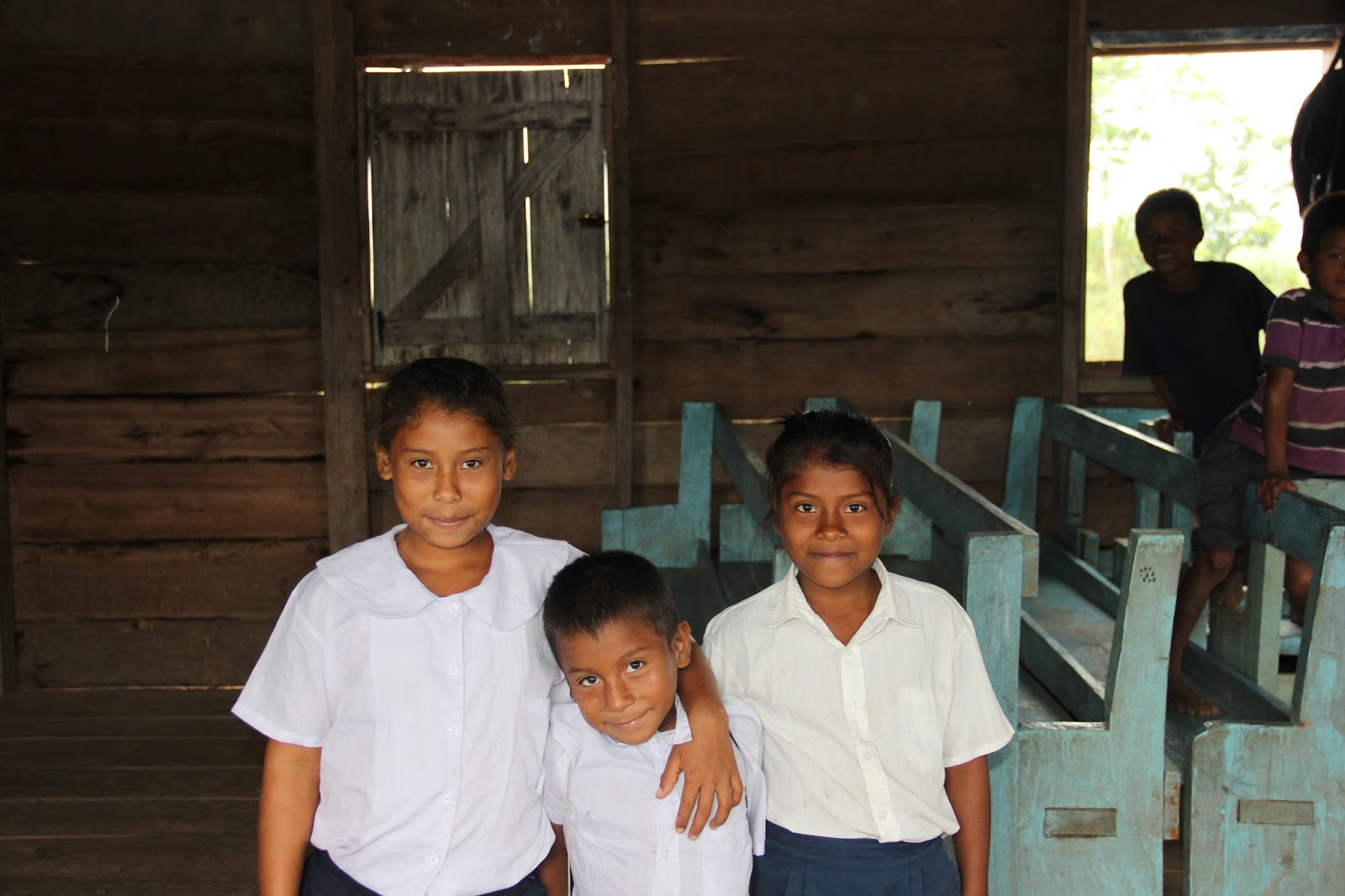
Dos Amigos is bigger than Auhya Pura. Here we deliver food aid to 409 people, of which 142 are children. “When the floods came, my parents were very sad," says Felton, a 13-year-old boy .


"We lost half of the crop. The house was also flooded," said the child's father, Fidel Gómez. “I have 12 kids and I do not know how I will feed my family. Until October we cannot replant and there are not enough seeds for everyone. Almost all people in the community have lost crops, we all need seeds. We are grateful for the food you are going to give us, because it solves the problem for a week. Now I am feeding my family with fish and bananas”. 

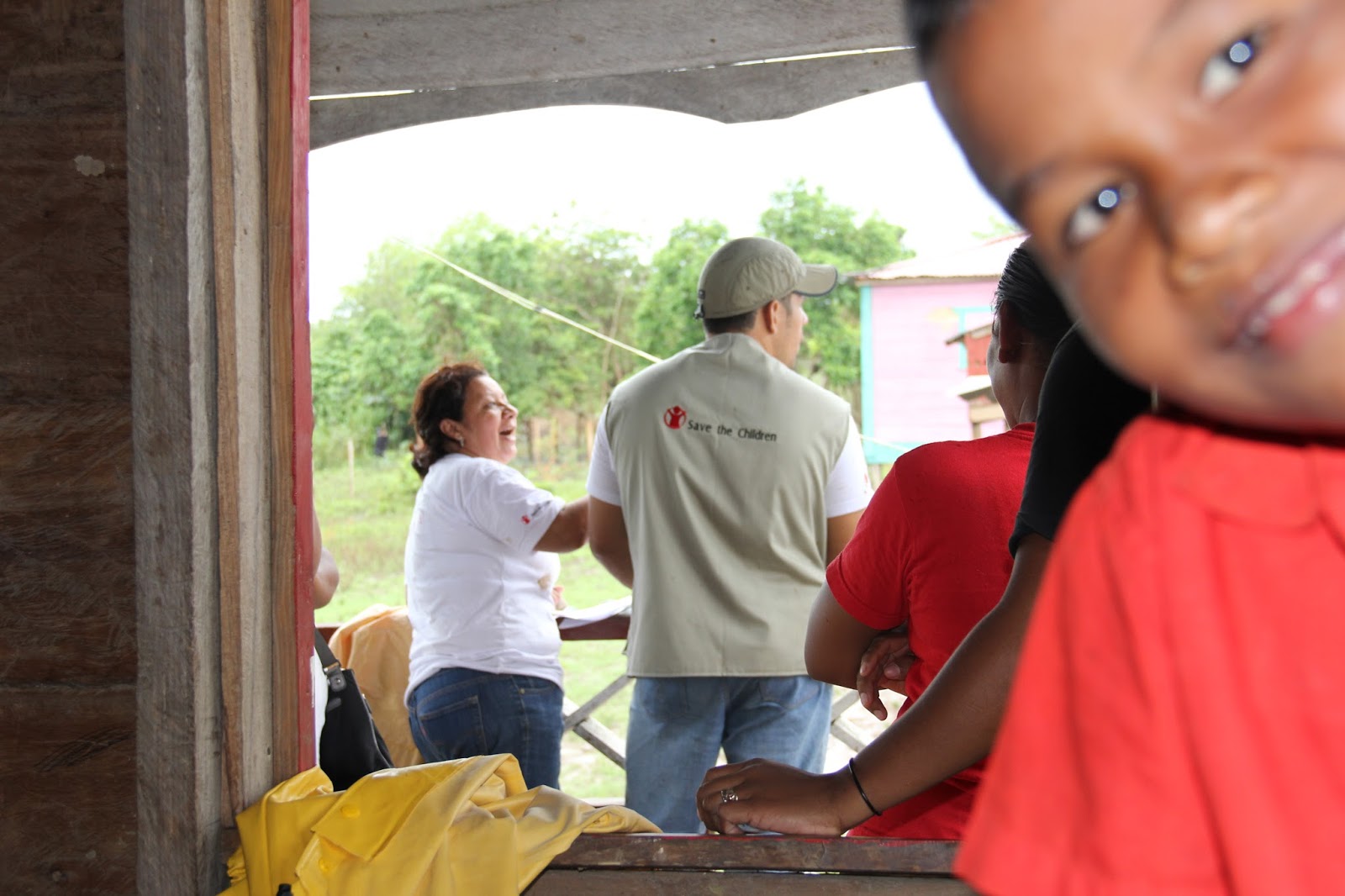
Felton’s family is one of the 68 families who are going to pick up the food aid of Save the Children.
It is easy to see how necessary is the food distribution here; not only because is palpable the poor conditions in which people live here, also because children are very thin and the treatment they give us is so grateful and hospitable.

EDUCATION


I like having school and studying”, says Felton with a big smile. However, access to school is a big problem for most children, because a part of the land is sunken and they can cross it only when the current is low. “When it rains, I cannot go because the bridge is still not finish. With this flood we did not go to school during two weeks”, explains us Felton, talking about the bridge that Save the Children is building. He and almost all children who are with us, walk barefoot through the mud.


Nilo Martínez, a teacher of Dos Amigos, tells us that “there are 105 children in this school and 4 teachers, but here they only can study up to 5th grade”. Although he does not speak well Spanish, he tries to explain as best as possible. He is shy and does not seem older than 30 years old. Clearly, he has not a lot of preparation, but assures us that "I love working here and teaching children."

A school teater in Alamikamba confirms that "most teachers of indigenous communities have not finished high school. Recently, a guy offered to teach in one of the communities but he only finished elementary school. They had to accept him because there was no one else”.
They invite us to eat; they give me a juice (with river water), but they are so nice and polite with me, so I drink it. Even though life here is hard and “rude”, the threat with us is very delicate and friendly. 

Friday, 16 August 2013

Auhya Pura, Indigenous Community

12.08.2013
After a few hours by boat, we arrive to Auhya Pura, a small community with houses along the river, where only Miskitu is spoken. The community leader comes with us to the church and we begin the process of food distribution. This church has been the "temporary school" for more than 6 years. Here, we are going to give food aid to 197 people, of which 113 are children


DISTRIBUTION OF FOOD AID

 "Some kids come without eating and come sad. Most families here have lost the entire crop. The food which you are going to distribute today is essential because many of them have not how to eat" says Tania Moody, one of the teachers of the community.

To find out how many aid we have to distribute, we did a census, we went house to house to count how many are affected by the floods. In this community, 31 households receive food aid. Then, they come with their ID and tell us how many people live per household, sex and age of each one.

The families are very numerous because the birth rate is high and parents are young. We are surprised that there are very few people over 60 years. It also surprises me that most do not know how to write and have to sign with the initials of their names or with the fingerprint.

In the community we are highly expected; since they heard a boat coming, they are waiting on the bank of the river. Children are very sweet and cheerful. They show me the new school and want to see the pictures I do.


COMMUNITY CONDITIONS

The community has very poor conditions. The houses are built on bases and are made of wood. Most are small and only have one or two spaces, although there are many people living in each house. 

Everything is full of mud and there are many animals dropping due to the overflowing of the river and flooding in the community. The latrines are also in very poor conditions; there are several parents who tell us that many children are sick due to lack of hygiene and contaminated water. 

Most people walk barefoot, including children. Kids are very happy and curious; they are playing all the time together. "I'm afraid to come to school when it rains, because we have to come by canoe and it is dangerous," says Ivania, a 10 years old girl who is surrounded by children. "Many children do not usually come due to the weather, because if it rains, because who live far away and have to come sculling, cannot come", tell us the teacher. However, Yoiner, an 8 years old boy, says "We are all friends, we always play together".


EDUCATION SYSTEM

"I am happy because I can come to school", tell us Yoiner, a 8 years old boy with a big smile, "I love adventure stories".
The teacher says, "Kids enjoy coming here and doing homework. All are very studious. But where we are now (in the church-"provisional school") they have many problems. We have not tables, then they write crouched on banks.

"I'm very happy because we will have a new school," says Ivania. "Our school is going to be the prettiest of the River" tells Yoiner, who is waiting for his parents to pick up food aid. This school is being built by the Christian Medical Action with funding from Save the Children, "next month it will be open, we are going to be the first to study there!" tell us Yoiner excited.


"They want to have lessons until 6th grade so we have more chances to end childhood education" says Ivania. "Most of the kids do not finish elementary school because there is no possibility to study up more than 4th grade here. Now we have around 70 children", tell us the teacher.


Thursday, 15 August 2013

Save the Children Nicaragua is carrying out a project in the in Alamikamba, the capital of the municipality of Prinzapolka, one of the eight municipalities of the North Atlantic Region (RAAN), near the Caribbean coast. The river runs through the town Prinzapolka and the communities have traditionally built their house around this. Due to heavy rains during July, the river overflowed and most of the houses and crops have been affected.
Save the Children is working in emergency response through a project that covers two aspects: food security and water and sanitation. We are distributing food to 490 families in 10 communities. Our organization is trying to meet the food needs of families who have suffered crop losses after rains. We are also working on cleaning wells in these communities, because the river water is contaminated. Moreover, in this county, we are also working with DIPECHO in the creation and maintenance of a stock of non-food items for emergencies.

Our funds for this project come from Save the Children Norway and the UK. We chose these 10 communities because we work with them with development projects and we feel responsibility to meet their needs. However, there are more communities affected by these rains that are in the same situation.

The answer is being as fast as possible but access to this area is very complicated, because the roads to Prinzapolka are in very poor condition and communities are accessible only with boats on the river.
On Monday 12th, we started with the distribution and we finish today. We have covered 490 families of 6 people each (on average). They have received food packs directly with: 14 pounds of rice, 7 of beans, 11 of sugar, 4 salt, 2 liters of oil, 14 pounds of a nutritional compound cereal. Moreover, the problem with crops is that these are purely for subsistence. Therefore, it is easy to lose all production since it is not customary to plant more than it is necessary to feed the family. We will spend more than $ 16,000 for food and distribution for this quick response, but the most expensive is the distribution. However, we have the help of another organization working in this area for years, Christian Medical Action –Acción Médica Cristiana-. 


The problem with the water: we did a study in more than 15 wells in each community, which get water from the river Prinzapolka. The results were that all the water is contaminated after the overflowing of the river, because the water of the latrines and wells are in the same level. We have two water and sanitation specialists but we are waiting for a water pump to clean and chlorinate the wells. This must be done in every community.

The DIPECHO project: it started in 2010 to create a stock in the town hall with  non-food items (buckets, food containers, blankets, etc.). The objective was to respond as quickly as possible, because access to the communities is very complicated and heavy rains are cyclical. Part of this stock has already been used, but thanks to the help of Save the Children Italy, we are recovering the humanitarian aid reserve.


One of the advantages that has SC is that we already have offices in Prinzapolka and Siuna, as well as transport and local counterparts. The language in this region is the "Miskitu", an indigenous language. But thanks to the people who are bilingual in Spanish and Miskitu, we can communicate with people in the communities where we work.
The key threat in this project is mainly the weather, as we are in winter, which is the most intense rainy season, but the climate is constantly changing. But there is also the problem of hygiene practices of these communities: for example, the habit of open defecation; the way to extract the water from the well (and the fact that children are usually those who do it); the routine of using well water for everything (human and animal consumption, to shower, to clean ...); lack of practice of drinking chlorinated water. Furthermore, the fact that almost all the houses are built on the bank of the river, causing great losses each time it grows. However, there are also examples of good hygiene habits, such as always take the shoes off before entering the house.


Save the Children started in Prinzapolka in 2010 with a DIPECHO project and we are in North Atlantic Autonomous Region (RAAN) for 13 years. After 2010, Save the Children tries to have more inclusive projects, especially about health promotion and education. We have not had any political or financial scandal, that is why Save the Children is well known and respected in this area. 


Friday, 9 August 2013


Save the Children is a non-governmental organization. Save the Children is the world's leading independent organisation for children. We work in around 120 countries. We save children's lives; we fight for their rights; we help them fulfil their potential.

We work to inspire breakthroughs in the way the world treats children and to achieve immediate and lasting change in their lives. Across all of our work, we pursue several core values: accountability, ambition, collaboration, creativity and integrity.


Save the Children in Nicaragua


Nicaragua is one of the countries with the highest poverty levels in the region and less progress reducing extreme poverty  Poverty affects the majority of the Nicaraguan population. The 46.2% of the population, almost each of two people, live in poverty. The 72% of children live in poor households and 41.6% live in extreme poverty (FIDEG, 2007).
One in four children (27%) shows slow physical growth and size. On average, the population living in poverty has only 2.2 years of education, while the non-poor have 5.5 years. Nearly one in every two people living in extreme poverty can not read or write.

In Nicaragua Save the Children will work for 6 goals directly related to the fulfillment of child rights:
  • Education. 
  • Health, nutrition, HIV, healthy water. 
  • Governance of children's rights. 
  • Child Protection. 
  • Disaster risk reduction. 
  • Food security and livelihoods. 

Our vision is a world in which all children's rights are fulfilled